
The E3 Leadership Code Explained
When I introduce the E3 Leadership Code, I often see heads nod. The concepts feel intuitive: Express. Engage. Execute. Powered by emotional qualities. Most leaders immediately agree with the framework. But understanding the Code is the easy part. Living it is where things become challenging. Execution rarely breaks down in strategy sessions. It breaks down in the conversations and handoffs happening every day.
It breaks down in half formed requests, unclear ownership, and work that is technically “done” but never truly accepted. You’ve probably heard the familiar phrases: “I sent it.” “They’re working on it.” “It should be done soon.” None of them sound dramatic, yet they quietly slow momentum, multiply follow ups, and fuel rework.
This is not a productivity issue. It is a commitment issue. And commitment is deeply human. Trust isn’t built through big gestures — vulnerability in town halls, courageous conversations, visible transparency. Those matter. But trust is also built in much smaller, quieter ways. Trust is built when I know exactly what you are committing to. Trust is built when we agree on what success looks like before work begins. Trust is built when you tell me the work is complete and I explicitly confirm it meets the mark.
Trust erodes when I have to guess. When I have to chase. When “done” means something different to each of us.
What Is the E3 Commitment Loop?
The E3 Commitment Loop is how the E3 Leadership Code comes to life in real time. It acts as a teaming agreement — a shared discipline for how we make and close commitments.
Before we get into the steps, there is something important to recognize. Every day, most of us rotate roles. In one conversation, we are the requester. In another, we are the performer. And often, we are both — receiving a commitment while simultaneously making one to someone else.
That rotation matters. When I see myself only as the requester, I can become impatient. When I see myself only as the performer, I can become defensive. But when I recognize that I live on both sides of the loop, my empathy increases. I ask better questions. I clarify expectations more deliberately. I become more thoughtful about the promises I make. This is where emotional intelligence lives inside execution.
Five Steps to Making Clear Commitments at Work
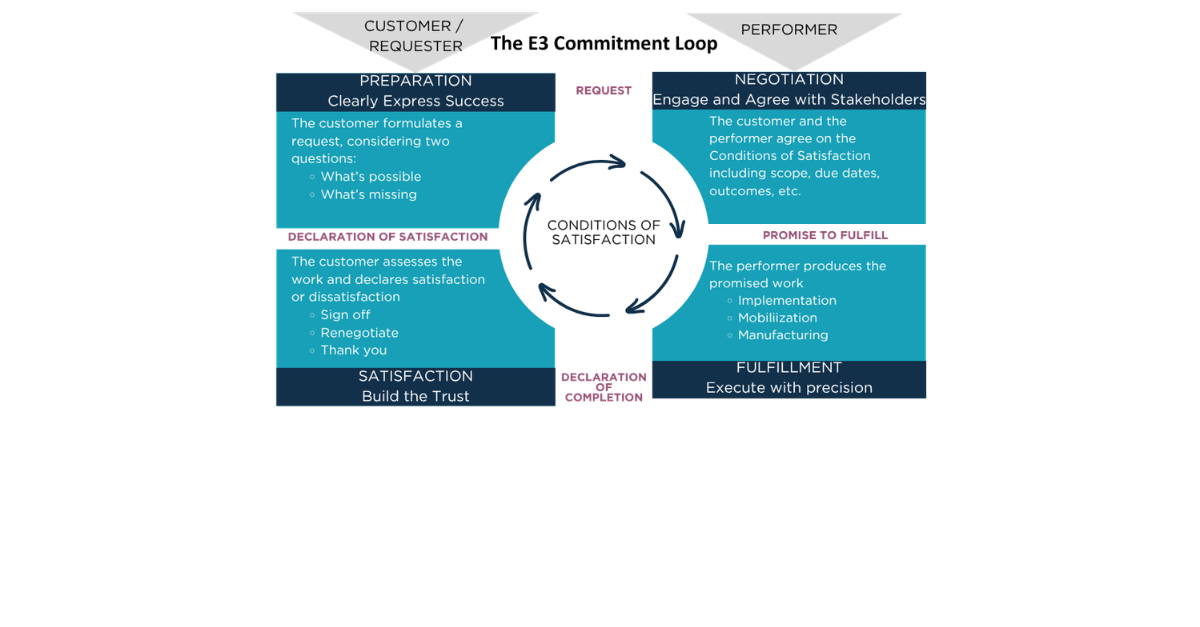
The Commitment Loop unfolds through five deliberate steps. They are simple — but powerful when practiced consistently.
1. A Clear Request
The Loop begins with a thoughtful request: What is needed, and why? What would success look like? This is Express in action — defining the end state before work begins.
2. Conditions of Satisfaction
Next, the customer and performer align on scope, timelines, quality standards, and ownership. Expectations become explicit, not implied. This is Engage at work — creating shared understanding before execution begins.
3. A Promise to Fulfill
The performer makes a clear, intentional commitment — not a casual “I’ll try.” This moment signals integrity and creates accountability
4. Declaration of Completion
Completion isn’t a quiet update in a system. The performer visibly declares the work complete. Execution includes both producing the work and making its completion visible.
5. Declaration of Satisfaction
The customer explicitly accepts the work — or renegotiates expectations if needed. This closes the loop and deepens trust. Without this final step, work may be finished technically, but remains emotionally unresolved.
The Meaning of “Done Done” in Teams
This is where the distinction between Done and Done Done becomes essential. Done means the task was completed. The document was sent. The presentation was delivered. The system was updated. Done Done means the agreed value was delivered, verified, and accepted. The difference is not operational nuance. It is relational clarity.
When teams stop at Done, they create more work. Follow-ups, corrections, escalations, and frustration fill the gap. When teams insist on Done Done, they build momentum. They reduce friction. They strengthen trust. Busy often comes from fixing what was never clear. Impact comes from closing what was clearly committed.
At the executive level, this is not about micromanaging tasks. It is about designing clarity into how the organization works. Unclosed commitments create rework, decision fatigue, and disengagement. Over time, those dynamics affect innovation, customer experience, and ultimately performance. Closed commitments, on the other hand, compound confidence and alignment.
The E3 Leadership Code provides the philosophy. The Commitment Loop provides the practice. Express defines success before work begins. Engage secures ownership and shared understanding. Execute closes the loop with visibility and accountability. Emotional qualities — awareness, integrity, empathy — sustain the trust that makes all of it possible.
Execution does not fail at action. It fails at commitment. And commitment, handled with clarity and emotional intelligence, is one of the most practical ways leaders build trust inside their organizations.
How to Build Better Commitment Habits
For teams beginning this practice, the Commitment Loop can feel structured or formal at first. That’s normal. You’re replacing habits of assumption with habits of clarity.
But over time, something shifts. The language becomes natural. “What are the conditions of satisfaction?” becomes a normal question. “Are we Done Done?” becomes part of how the team speaks. “Are you satisfied?” becomes a closing, not an afterthought.
The structure fades into rhythm. The formality dissolves into fluency. And what remains is a team that trusts each other more deeply because expectations are clear and commitments are honored.
This is not process for the sake of process. It is shared language that makes execution easier — not heavier.
If you pause and reflect on your own team, where does commitment break down? At the request? At ownership? Or at the declaration of satisfaction?
If you want your team to make clearer commitments, close loops faster, and reduce rework, I can help. Let’s build the commitment habits that move your organization forward — with less friction and more trust.