
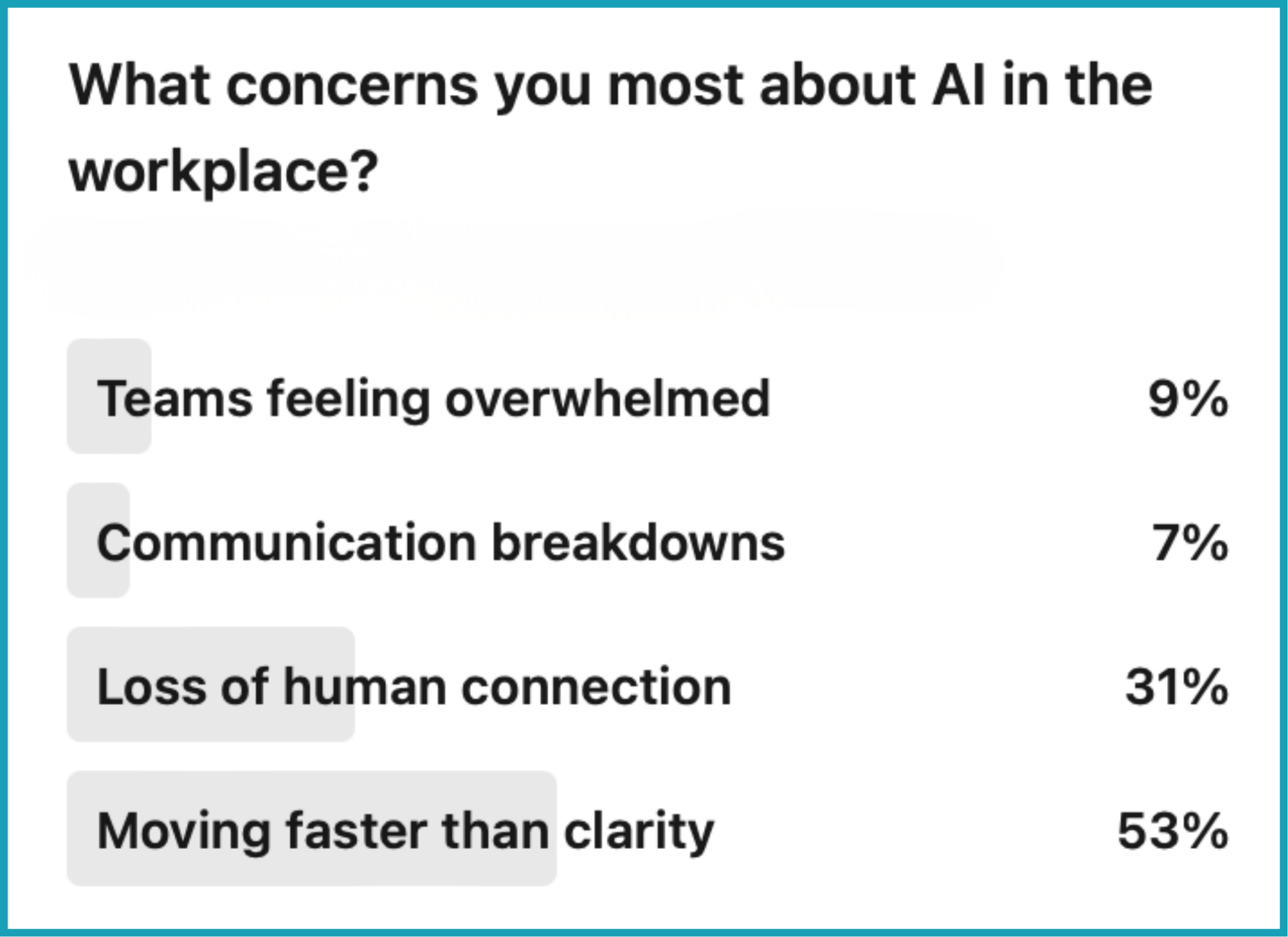
We asked a simple question: What concerns you most about AI in the workplace?
The responses pointed to something deeper than concern about a new technology. While there were worries about communication breakdowns and overwhelmed teams, the two strongest responses were moving faster than clarity (53%) and loss of human connection (31%).
As I reflected on the poll results, I found myself thinking back to dozens of transformations (acquisitions, large-scale transformations, technology implementations, outsourcing initiatives, and operational redesign) I have been part of throughout my career. Different industries. Different technologies. Different business challenges. Yet the same leadership lesson kept showing up:
Technology only creates value when people embrace it.
What makes this moment different is speed. AI is accelerating information flow, compressing decision cycles, and raising expectations. Without clarity and connection, that speed can push people into confusion, resistance, or disengagement long before leaders realize what is happening.
That is why AI is becoming a test of leadership as much as an opportunity for technology.
AI Is Acting Like a Spotlight
AI is not creating entirely new problems. It is revealing existing ones faster. At the center of those concerns is one of leadership’s oldest responsibilities: clarity.
Several comments captured this well. One leader noted that many leaders are learning about AI at the same time as their teams and are being asked to provide direction while still finding their own footing. Another observed that as AI accelerates tasks and decision-making, the challenge is keeping those decisions aligned with long-term goals.
Speed alone does not create success. It magnifies whatever already exists within an organization. If communication is inconsistent, priorities are unclear, or trust is weak, AI can accelerate confusion, frustration, and drift.
The technology is not creating those conditions; it is making them easier to see and harder to ignore. When leaders provide clear direction, teams adapt more effectively. When they do not, misalignment spreads faster than ever.
For years, leaders could often hide behind process, structure, or hierarchy. AI makes that harder. When communication is unclear, people know. When priorities conflict, people feel it. When trust is weak, adoption stalls.
The speed of AI simply makes leadership gaps visible sooner.
The Human Element Is Becoming the Competitive Advantage
If AI exposes the strength of leadership, adoption reveals the emotional experience of change. People do not resist transformation only because they do not understand the technology. They resist when change triggers fear, threatens identity, creates uncertainty, or raises doubt about what comes next.
That is one reason the people side of transformation matters so much. In AI Transformation Is a Workforce Transformation, BCG notes that about 70% of the value created through AI transformation comes from rethinking the people component rather than the technology itself.
When I coach leaders through change, I ask them what is preventing people from embracing it. More often than not, those barriers come down to FEUD:
Fear. Ego. Uncertainty. Doubt.
Under pressure, FEUD shows up everywhere. AI did not create FEUD. It simply gave it a new target.
• Fear: “Will my skills still matter?”
• Ego: “I don’t need AI.”
• Uncertainty: “What does this mean for my role?”
• Doubt: “Is this really going to happen or will it be shelved like other technology plays?”
Technology may be changing rapidly. Human nature is not.
People still need clarity, trust, and a sense of purpose. They need to feel seen, heard, valued, and included. Technology can provide information, but it cannot create trust, inspire confidence, or help people make sense of uncertainty. Those responsibilities still belong to leaders.
Imagine two organizations approaching AI adoption. One treats it as a technology rollout. Leadership announces the initiative, mandates adoption, and measures usage. Employees are left to interpret what it means for their future.
The other treats it as a leadership challenge. Leaders paint a clear picture of why AI matters, how it supports both organizational and individual success, and how people can help shape the journey. They invite questions, acknowledge uncertainty, and build trust alongside capability.
Both organizations may have access to the same technology. The outcomes will likely be very different—not because one company had better tools, but because one remembered that transformation happens through people, not to people.
Why the E3 Leadership Code Matters
This is where the E3 Leadership Code becomes practical. If leaders want people to move through change rather than resist it, they need a leadership system that creates clarity, connection, and aligned action.
At its core, the E3 Leadership Code challenges leaders to do three things exceptionally well:
• Express a clear vision, so people understand where they are going and why it matters.
• Engage people in the journey by building trust, creating connection, and helping them see how they contribute to success.
• Execute by creating the alignment, accountability, and support necessary to turn vision into results.
Those responsibilities are strengthened by the emotional qualities of leadership: Awareness, Curiosity, Empathy, Authenticity, Courage, Inspiration, Gratitude, Integrity, Empowerment, and Enablement. These qualities help leaders navigate uncertainty without losing connection and create environments where people can adapt, learn, and perform at their best.
What Leaders Must Do Now
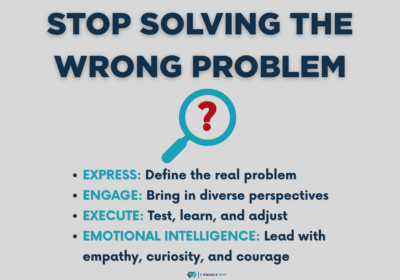
The answer is not to slow down innovation or become an AI expert overnight. It is to strengthen the capabilities technology cannot replace: Express, Engage, and Execute, powered by Emotional Qualities.
• Create clarity before people create assumptions.
• Communicate the purpose behind decisions, not just the decisions themselves.
• Invest time in trust and connection, especially when change accelerates.
• Help people understand how new technologies support both organizational success and individual growth.
The organizations that thrive in the AI era will not be those with the best technology alone. They will be the ones that pair technology with human-centered leadership and recognize that while AI can accelerate work, leadership still determines whether people trust, adapt, collaborate, innovate, and perform together.
The more advanced our technology becomes, the more important our humanity becomes.